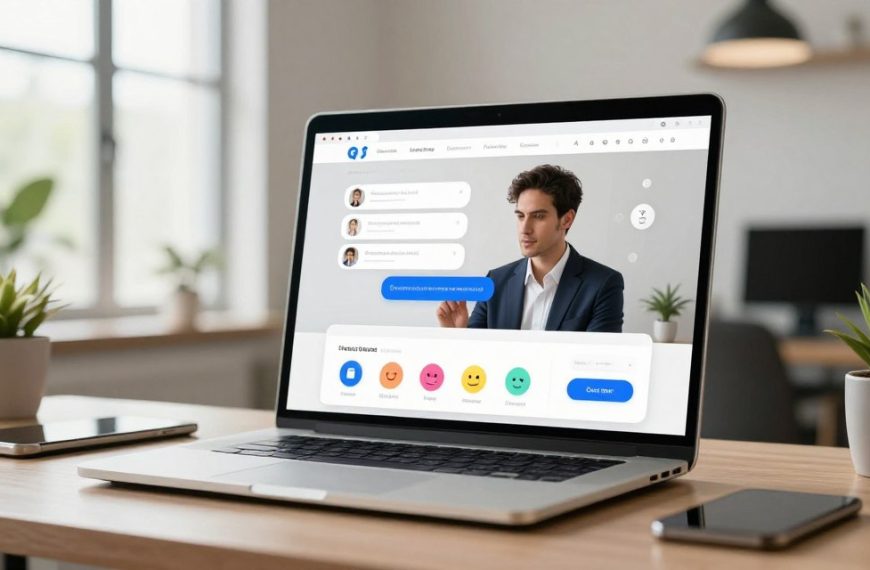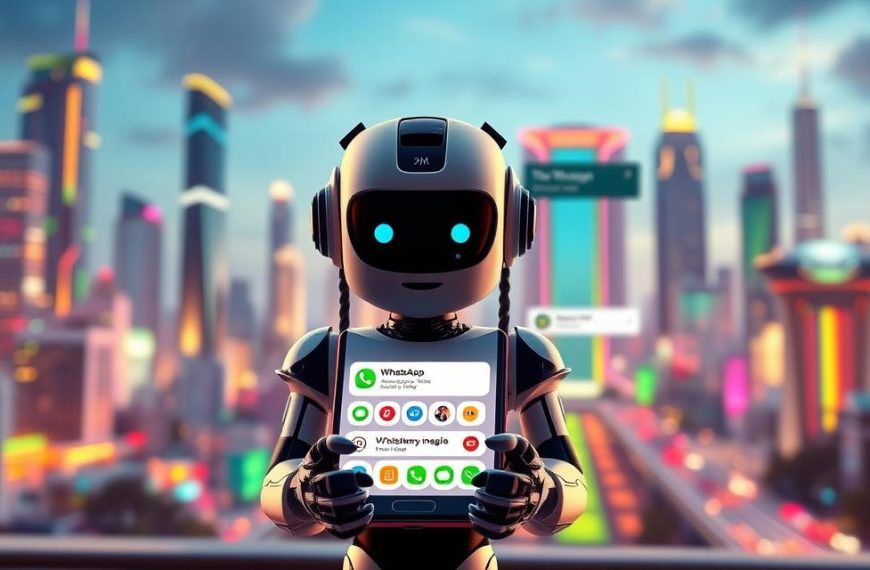
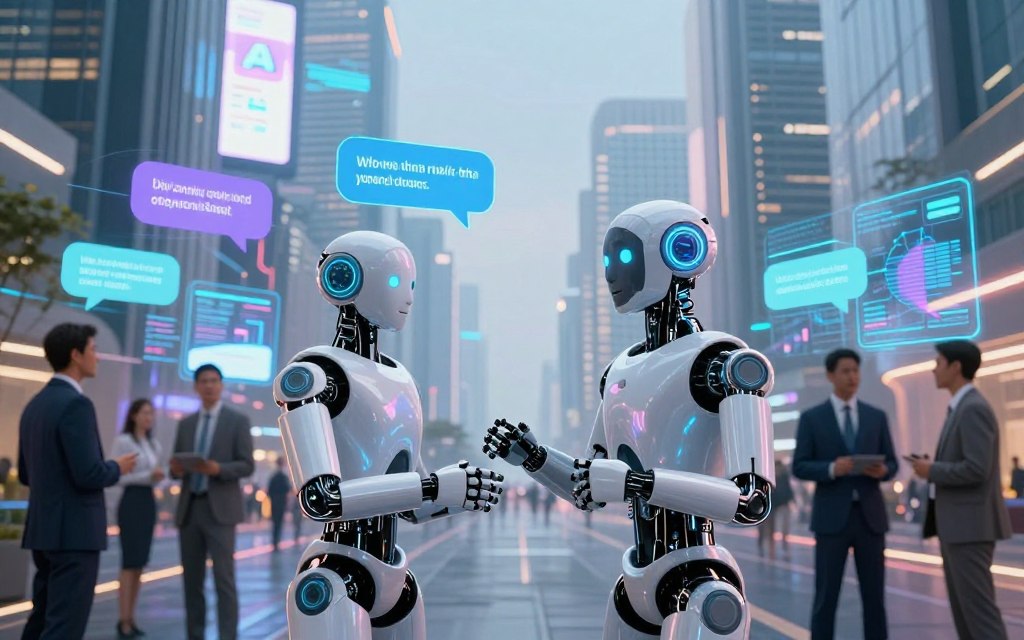

The world of artificial intelligence is changing fast. This change could make businesses better, improve how we talk to customers, and spark new ideas in many fields.
We’re leaving behind the days of simple chatbots. Now, AI can understand and think deeply. It’s set to change how we interact with computers.
For companies and society, keeping up with AI is essential. The future of artificial intelligence, like conversational AI, is becoming key to our digital lives.
This shift brings big chances for better work and more fun interactions. But, it also raises big questions about fairness, jobs, and safety. We’ll look closely at these important issues.
The Evolution of Conversational AI
The story of chatbots has been unfolding for decades. It’s a mix of small steps and big leaps. Understanding this evolution of conversational AI helps us see how we got to today’s smart systems. We’ve moved from simple scripts to conversations that feel almost human.
From Simple Scripts to Complex Dialogues: The Journey from ELIZA
In 1966, Joseph Weizenbaum at MIT created ELIZA. This early chatbot used simple rules to match user input. It had no real understanding of language or context.
ELIZA looked for keywords in what users said. Then, it gave back scripted answers based on those keywords. Its most famous script, DOCTOR, made it seem like a psychotherapist by asking questions.
For years, chatbots followed this pattern. They were like complex decision trees. They could only handle a few specific commands and phrases. This made them good for certain tasks but not for free-flowing conversations.
The Machine Learning Leap: Siri, Alexa, and Predictive Responses
Things changed with the use of machine learning and big data. Siri (2011) and Alexa (2014) brought a new era. They moved beyond simple rules.
These virtual assistants used statistical models and natural language understanding (NLU). They could understand what users meant, like “Will it rain later?” Their answers were predictive and context-aware, even if they were pre-recorded.
This was a move from scripted replies to intelligent retrieval. These assistants could do things like set alarms and check the weather. They could even control smart devices by guessing the right action. But they struggled with long conversations and creating new, nuanced language.
The Paradigm Shift: Generative AI and Models like ChatGPT and Google Bard
The real change came in 2017 with the Transformer architecture. This led to Large Language Models (LLMs). These models learned from almost all internet data, understanding word relationships on a huge scale.
This shift marked a big change from systems that just fetched answers to ones that could generate them.
Models like OpenAI’s ChatGPT, Google Bard (now Gemini), and Anthropic’s Claude are examples of generative AI models. They don’t just find answers; they create them word by word. This lets them write essays, debug code, and have open-ended conversations.
The abilities of these generative AI models are huge. They keep track of conversations, adjust their tone, and create new information. This makes them more than just tools; they could be collaborators, tutors, and creative partners.
The paradigm shift is clear: we’ve moved from machines that follow rules to ones that learn and generate their own. The future of chatbots is being shaped by these advanced generative AI models. They promise even more intelligent and integrated interactions.
Deconstructing the Technology: NLP, LLMs, and Beyond
Modern chatbots use advanced tech to talk like humans. They go beyond simple answers. They understand context and create text that sounds almost human.
We need to look at the key parts: natural language processing (NLP), Large Language Models, and multimodal integration.
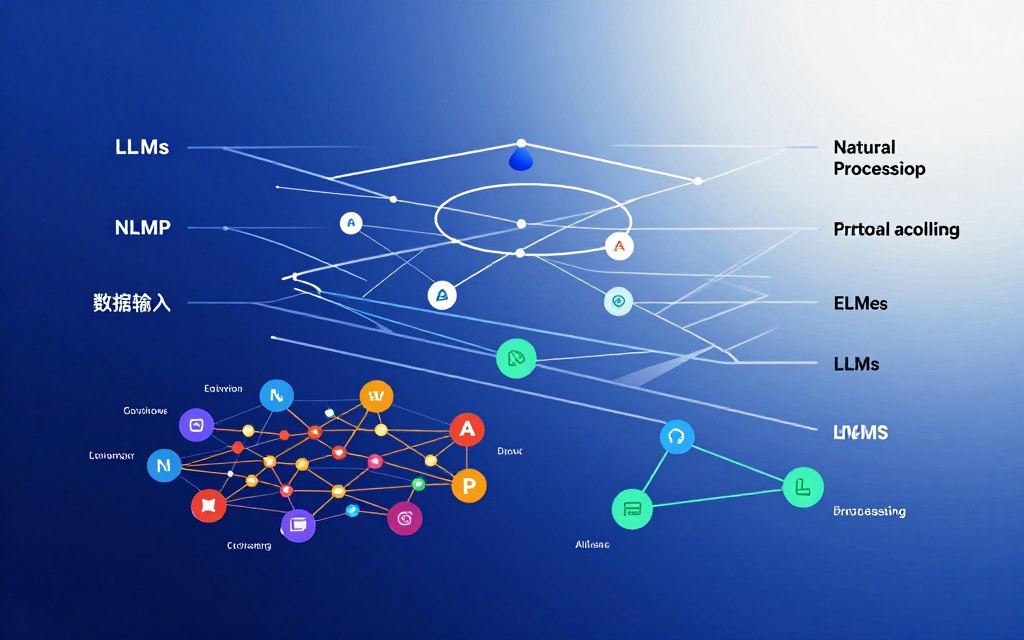
Natural Language Processing: How Chatbots Understand Us
Natural language processing (NLP) lets machines understand human language. It turns text or speech into data computers can use. This involves several steps.
First, tokenisation breaks down text into words or sub-words. Then, sentiment analysis checks the emotional tone. This helps the chatbot respond correctly.
The most important step is intent recognition. It finds the user’s real goal. For example, “What’s the weather?” and “Will I need an umbrella today?” both ask for the weather. This way, the chatbot knows what to do next.
The Engine Room: How Large Language Models Are Built and Trained
Large Language Models (LLMs) like GPT-4 and Google’s PaLM create fluent responses. They are huge neural networks with billions of parameters.
Building them is a huge job. They’re trained on huge amounts of data. This teaches them about words, grammar, and more.
They don’t just memorise. They predict the next word in a sequence. This lets them write essays or have conversations.
The Next Frontier: Multimodal AI and Voice-Visual Integration
The future is about more than text. Multimodal AI systems use text, voice, images, and video. This makes interactions more natural.
Imagine showing a chatbot a photo of a plant and asking about its leaves. The AI would look at the photo and use its knowledge. Or think of a voice-activated assistant that sees you pointing at a lamp.
This mix with other tech is key. It lets chatbots control smart devices. In shops, augmented reality (AR) could show product info on your camera view. This shows a future where AI is our main way to interact with the world.
A Transformation in Customer Service and Retail
Chatbots are changing how businesses work, making service and sales better. They do more than just answer simple questions. They are changing how companies talk to customers and run their operations.
Providing Instant, Scalable Support and Capturing Leads
Customer service automation is key because it offers help anytime. Unlike people, AI agents never need a break. They can talk to many customers at once, making service more efficient.
This support is great for handling lots of simple tasks. It includes:
- Answering common questions about business hours, returns, or tracking.
- Providing real-time account balances or transaction status updates.
- Collecting initial information for support tickets, ensuring human agents have full context.
- Qualifying sales leads by asking preliminary questions and directing prospects to the right resource.
In banking, chatbots handle balance checks and fraud alerts. Telecoms use them for internet issues and billing. These chatbot applications are essential in many industries.
For big online shops, chatbots are a must. They check order status, start returns, and give delivery updates. This makes customers happier and saves money.
A study on AI in business found, “Generative AI has already increased task automation for many firms, mainly in customer-facing roles.” This frees up money and people for more important things.
The Rise of the Personalised Shopping Concierge
Chatbots are becoming more than just help tools. They use your buying history and what you’re talking about to suggest things. It’s like having a personal shopping assistant.
Imagine a bot that remembers you bought a printer. It might suggest ink cartridges later. Or, it could recommend luggage for your travels based on what you like.
This change makes the sales process better. The chatbot helps you from the start to making a decision. It’s a smart way to boost sales.
Evolving the Human Agent’s Role to Complex Problem-Solving
Chatbots don’t make human agents useless. They make their jobs better. Chatbots handle simple tasks, so humans can deal with harder problems.
The human role is changing to:
- Advanced Problem-Solving: Dealing with tricky technical issues or unusual complaints.
- Emotional Intelligence and Empathy: Handling customer frustrations and building loyalty.
- Strategic Sales and Consultancy: Doing high-value negotiations and building client relationships.
This mix makes service better. Chatbots handle simple tasks, and humans solve complex ones. This is what chatbot applications aim for: to help people do more valuable work.
Revolutionising Healthcare Delivery and Support
Conversational AI is making a big difference in healthcare. Healthcare chatbots are becoming key in medical care. They help with staff shortages and more patients by providing smart support.
This tech makes healthcare better and more efficient. It helps with mental health and managing long-term conditions. AI makes health care more personal and responsive.

Accessible Mental Health First Responders: Woebot and Wysa
AI companions like Woebot and Wysa offer mental health support anytime. They use cognitive behavioural therapy to help users. It’s a safe space to talk about feelings and learn to cope.
These chatbots are always there, filling gaps in traditional services. They’re not a full replacement for therapists but offer vital support. They help with mood tracking, mindfulness, and escalating serious issues.
Streamlining Care: AI-Powered Triage and Administrative Automation
AI is making patient intake and care planning easier. It uses smart symptom checkers for initial assessments. This helps patients know if they need urgent care or can manage symptoms at home.
AI also handles the boring admin tasks. It schedules appointments, sends reminders, and collects medical history. This lets doctors focus on what they do best.
Reducing Burden on Clinical Staff and Improving Patient Flow
Healthcare chatbots reduce burnout and improve workflow. They handle routine questions, freeing up nurses and doctors. This means more time for complex cases and patient care.
AI also speeds up disease detection and drug discovery. It helps monitor patients virtually. This leads to better patient flow and more efficient use of medical resources.
Supporting Long-Term Health: Medication Reminders and Chronic Care Coaching
AI chatbots are great for chronic illness management. They send reminders, track symptoms, and offer lifestyle advice. This helps patients stick to their treatment plans.
These chatbots offer ongoing support. They help with medication adherence and empower patients. Specialised apps, like for cancer risk assessment, provide tailored advice and follow-ups.
This change from episodic to continuous care is a big step forward. It turns smartphones into tools for long-term health.
Personalising and Democratising Education
The promise of AI in education is exciting. It aims to give every student a personal tutor and every teacher a powerful assistant. This change goes beyond just digitising books or managing classrooms. It’s about making learning fair and effective, where technology meets human needs.
The AI Tutor: Creating Adaptive Learning Pathways for Every Student
Imagine a learning buddy that never gets tired and always understands you. This is what AI-powered tutors offer. They use smart algorithms to check how well you understand, find gaps in your knowledge, and offer the right practice or explanations.
For someone struggling with algebra, the chatbot can go back to basics. For someone ahead, it can introduce harder topics. This adaptive learning ensures no one is left behind because of a standard curriculum. It makes personal learning a reality for everyone.
These tools are becoming more than just Q&A bots. They can lead debates, guide science projects, or check your writing. They act as a constant, supportive study partner.
Liberating Educators: Automating Grading, Feedback, and Planning
While AI tutors help students, educational chatbot technology is changing teachers’ roles. A lot of a teacher’s time is spent on tasks like grading and planning lessons.
AI can do these tasks well and fast. It can check essays for structure and grammar, freeing teachers to give deeper feedback. It can also help plan lessons and find educational materials, saving hours.
This change is a big win for AI in education. It lets teachers focus on what matters most: sparking curiosity, leading discussions, and supporting students’ wellbeing.
Navigating the Challenges: Ensuring Academic Integrity and Fostering Critical Thought
But there are big challenges ahead. The main one is keeping learning honest. If AI can write essays, how do we know if students really understand? The answer is AI detection tools, but this could lead to a race.
Another big challenge is making sure technology doesn’t replace deep learning. AI is great for memorising facts, but it can’t replace critical thinking and creativity. We need to teach these skills more.
Most importantly, we must remember how students learn best:
“Children don’t learn from content alone—they learn through connection… Without a sense of belonging, the brain’s capacity to learn is diminished.”
No algorithm can replace the trust and motivation a caring teacher gives. The goal of AI in education should be to enhance that human connection. By handling routine tasks, AI can free teachers to focus on building relationships and fostering a love for learning. The future classroom will be a place where human empathy and technology work together to unlock every student’s full ability.
How Will Chatbots Change the World of Business and the Workforce?
Business operations are on the verge of a big change. Conversational AI is starting to automate and improve core functions. This workforce transformation AI is happening now, changing daily tasks and long-term plans. The need for efficiency and insight is driving its adoption, moving beyond simple customer queries.
Automating Knowledge Work: From Reports to Data Analysis
Chatbots are now automating repetitive, data-heavy tasks. They can draft reports, summarise meeting notes, and analyse large datasets quickly. This business process automation saves costs and frees human workers from boring tasks.
These AI tools also find patterns and insights in data that humans might miss. They turn raw data into useful information.
Impact on Roles in Marketing, HR, and Finance
This change affects key departments. In marketing, AI helps with content ideas, draft creation, and campaign analysis. It lets teams test more ideas quickly.
HR uses chatbots for initial candidate screening, answering FAQs, and onboarding. This makes administration smoother and lets HR focus on culture and complex employee relations.
In finance, routine tasks like report generation and data entry are automated. This reduces errors and lets analysts focus on forecasting and strategy.
Augmenting Human Creativity and Strategic Decision-Making
The story is changing from job replacement to job augmentation. AI is a powerful collaborator for creative and strategic roles. It crunches numbers and provides scenarios, but humans add context, ethics, and creativity.
As one expert notes,
“Workers in creative positions are more likely to have their jobs augmented by AI, not replaced.”
This partnership leads to more innovative solutions. A marketer uses AI for data but crafts the brand story. A manager uses AI reports to make strategic decisions.
The Critical Response: Workforce Reskilling and the Redefinition of Jobs
This transformation needs a critical response from leaders and policymakers. Fear of job losses is understandable, but inaction is riskier. The focus should be on preparing the workforce for new roles.
Investing in education is essential. One of the absolute prerequisites for AI success is investing in education to retrain people for new jobs. Businesses must upskill employees to work with AI tools.
Governments should support this transition with policy and funding for lifelong learning. This collaborative effort can turn disruption into opportunity, redefining jobs around uniquely human skills. The future of work depends on a successful workforce transformation AI strategy, where business process automation enhances human abilities.
Navigating Ethical Quandaries and Societal Risks
Conversational AI is advancing fast, but it brings up big ethical questions and risks. For every benefit, like making things more efficient and connecting us, there’s a risk that needs careful thought and action. We’ll look into the challenges that need to be tackled to make sure chatbots help everyone fairly and safely.
Addressing Algorithmic Bias and Ensuring Fairness
Chatbots learn from huge amounts of human language, which often has our biases. If a model is trained on text that doesn’t show all groups fairly, it might not be fair in its answers. This could lead to unfair results in things like loans, jobs, or legal advice.
To fix this, we need a few steps. Developers should use diverse data for training. Also, AI systems should be checked regularly for unfair outputs. Tools and methods are being made to find and fix bias, making fairness a key part of AI design.
Safeguarding Data Privacy in an Age of Personalised Conversation
Chatbots ask for personal info, making a big data pool. The main risk is how this data is kept, used, and might be misused. Breaches could cause identity theft, blackmail, or unwanted surveillance.
Strong privacy measures are a must. This means using end-to-end encryption, being clear about data use, and letting users control their info. The idea of collecting only what’s needed should guide ethical AI development.
The Economic Equation: Analysing Job Displacement Versus Creation
AI might replace jobs, mainly in tasks that involve talking and getting info. Customer service, telemarketing, and basic data entry are at risk. But, new jobs often come with old technology.
The economic effect depends on training and adapting quickly. While some jobs might go, new ones in AI management, prompt writing, and human-AI teamwork are coming. It’s important to manage this change well.
| Sector at Risk of Displacement | Potential New & Augmented Roles | Key Skill Shift Required |
|---|---|---|
| Basic Customer Support | AI Trainer & Conversation Designer | From script-following to system optimisation |
| Data Entry & Processing | AI Data Analyst & Integrity Manager | From manual input to data interpretation & quality control |
| Routine Content Creation (e.g., simple reports) | AI Content Strategist & Editor | From generation to creative direction & fact-checking |
Combating Misinformation, Deepfakes, and the Erosion of Trust
AI can create fake audio and video, and spread false information. This can change opinions, harm reputations, and threaten democracy. It’s hard to tell what’s real and what’s not.
Also, AI companions raise psychological issues. People who talk deeply with chatbots might feel lonelier, even though they’re trying to connect. This can lead to unhealthy emotional dependence.
Researchers found that users who engaged in the most emotionally expressive conversations with the chatbot also reported higher levels of loneliness.
Groups like Common Sense Media advise against AI companions for kids under 18. They say it’s bad for social and emotional growth. We need to make sure these tools are safe and teach users how to use them wisely. Solving these ethical AI challenges means building safety nets. It’s about working together to make sure AI helps, not hurts, our society.
Envisioning the Future: Ubiquitous and Integrated AI
The next step for chatbots is to become invisible and manage our world. This future of artificial intelligence sees systems that are ambient and integrated into our surroundings. Conversational AI will be at the heart of a smarter, more responsive world.
Becoming the Central Interface for Smart Homes and Cities
Imagine controlling your home’s systems with just a conversation. This is what conversational AI promises for the Internet of Things (IoT). It will manage everything from your fridge to your car.
In cities, AI could make infrastructure better. Citizens could report issues by talking to a city AI. It could also improve traffic flow by adjusting signals.
The Development of Emotional Intelligence (Affective Computing)
The next step is for AI to understand our emotions. This field, affective computing, uses sentiment analysis and emotion detection. Chatbots will look at our voice, face, and heart rate.
A mental health bot could detect anxiety in your voice and offer help. Customer service agents could also sense frustration and act faster. This emotional intelligence builds trust and supports more human-like interactions.
Convergence with Robotics: Chatbots Guiding Physical Actions
Chatbots will soon control robots. In a warehouse, an AI could direct a robot to pick items by voice command.
In healthcare, a robot could fetch medicine for the elderly while chatting. This lets conversational AI perform tasks in the real world through voice commands.
This integration could speed up scientific research. Dario Amodei of Anthropic believes AI could make research ten times faster. AI assistants could help design experiments and control lab robots, speeding up discovery.
Conclusion
Chatbots are changing the world, and it’s no longer just a guess. They offer instant answers like ChatGPT and mental health support like Woebot. This tech is changing how we get services, healthcare, education, and work.
This change brings big wins in efficiency, personalisation, and making things more accessible. But, it also brings big challenges like bias in algorithms, privacy issues, and jobs being lost. We need to understand both the good and the bad sides of this.
The future of chatbots depends on what we choose to do. Companies like OpenAI and Google must design with ethics in mind. Governments should make smart rules. Businesses should help people, not replace them.
We must focus on keeping human values at the heart of this change. By making smart choices, we can use chatbots for good. We can protect human dignity and keep real connections alive.
FAQ
What was the key technological milestone that enabled modern chatbots like ChatGPT?
The big breakthrough was the Transformer architecture. This innovation is at the heart of Large Language Models (LLMs) like GPT-4 and Google’s Gemini. It lets them understand and create human language in a much more advanced way.
They can process huge amounts of text and spot complex patterns. This is way beyond simple rules.
How do chatbots like Siri and Amazon Alexa actually understand what I’m saying?
They use a field of artificial intelligence called Natural Language Processing (NLP). First, they break your speech into words or parts of words.
Then, they look at the sentence structure and figure out what you mean. For example, “play music” or “set a timer”. They also find important information like a song title.
This lets them understand your request and do something about it.
In customer service, will chatbots completely replace human agents?
No, the goal is to work together, not replace each other. Chatbots are great at handling lots of simple questions.
This frees up human agents to deal with more complex issues. They can handle things that need empathy and creative problem-solving.
Are AI mental health chatbots like Woebot a substitute for therapy?
They are meant to be a starting point, not a full replacement. Apps like Woebot and Wysa offer helpful tools and support.
They can give you techniques like Cognitive Behavioural Therapy (CBT) exercises. But for serious mental health issues, they should not be the only help you get.
How can chatbots be used to personalise education for students?
AI can adapt to each student’s learning pace. It looks at how well they’re doing and what they need to work on.
Then, it can adjust the questions and resources to fit the student’s level. This makes learning more tailored to each person.
What is the biggest ethical concern surrounding the use of advanced chatbots?
The biggest worry is bias in the algorithms. If a chatbot learns from biased data, it can make unfair decisions.
This is a problem in areas like hiring or law enforcement. To avoid this, we need diverse training data and regular checks for bias.
What does “multimodal AI” mean for the future of chatbots?
Multimodal AI means chatbots can understand different types of input. This includes voice, images, and video.
In the future, a chatbot could diagnose a plant disease from a photo or help you with a task using augmented reality. It’s about making interactions more natural and flexible.
How is affective computing changing chatbot development?
Affective computing is about making chatbots understand emotions. They can look at your voice, words, or even your face to guess how you’re feeling.
This lets them respond in a way that feels more empathetic. For example, they might sound calmer if you’re upset or more encouraging if you’re struggling.
What can businesses do to prepare their workforce for increased chatbot integration?
Businesses should focus on training employees for new roles. They need to identify tasks that will be automated and teach skills that are uniquely human.
Skills like problem-solving, creativity, and emotional intelligence are key. The goal is to help employees work alongside AI, not just be replaced by it.
Can chatbots connected to the Internet of Things (IoT) manage a smart city?
This is a big area for future development. A chatbot could be the main way for people to interact with city services.
It could also work with IoT sensors to improve traffic flow, manage energy, or coordinate emergency services. This could make cities more efficient and responsive.

 By
By