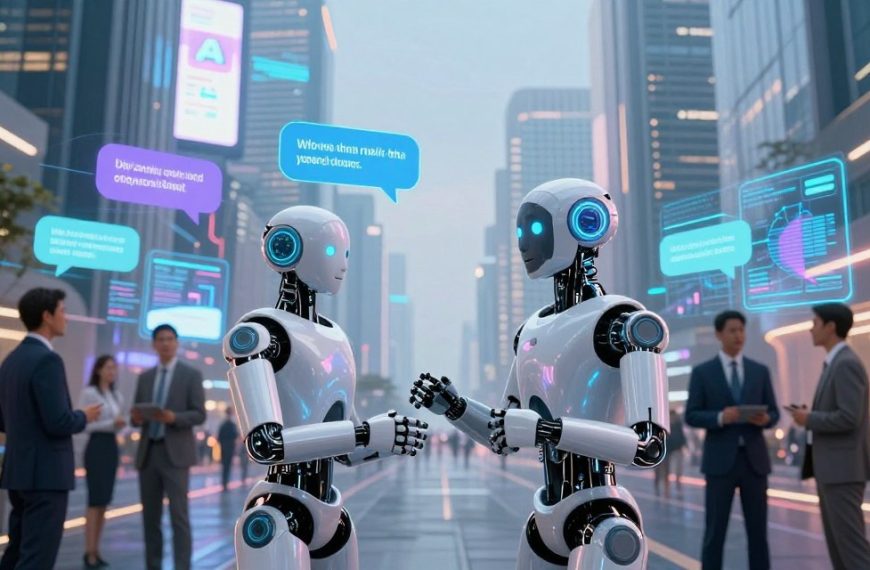


In today’s world, we’re more connected than ever before. Yet, many feel lonely. This loneliness comes as AI, like chatbots, gets better at talking like us. They offer friendship whenever we need it.
Now, we wonder: are these AI systems real people? The line between AI and genuine human connection is blurry. It’s a big question for our society and our beliefs.
It’s important to understand the difference between AI chatbots and real human interaction. This knowledge affects psychology, ethics, and our communities. We aim to shed light on this boundary with a clear and professional view.
The Pervasive Rise of Conversational AI
Artificial intelligence has moved from just answering customer service calls to becoming companions for millions. This change has deeply affected how we interact with each other. Now, conversational AI goes beyond simple tasks to offer emotional support and even therapy.
Platforms focused on AI companionship show how common this has become. For example, users of Character.ai spent 93 minutes daily with chatbots in 2024. This is as much time as people spend on big social media sites.
Apps like Replika.ai, Character.ai, and China’s Xiaoice have attracted hundreds of millions of users. They are not just about tech. They tap into real needs, like the growing problem of loneliness and social isolation.
This widespread use has made us ask if chatbots are like people. It’s no longer just a tech question. It’s a big social issue that affects how we connect and find comfort.
2. Defining the Chatbot: From Simple Scripts to Large Language Models
Chatbots have changed a lot, moving from simple scripts to complex dialogue engines. This change shows why today’s AI is so different. It’s a shift from predictable programs to systems that can surprise us.
2.1 Rule-Based Systems: ELIZA and Early Limitations
The first chatbots, like ELIZA from the 1960s, followed simple rules. They matched patterns in user input to find keywords. Then, they gave back pre-written answers or asked the user’s question again.
These systems didn’t understand context or meaning. Users soon reached the limits of the script. The conversations felt stiff and artificial. Researchers said they were like clever parrots, not thinking beings.
2.2 The Generative AI Revolution: GPT-4 and Beyond
Everything changed with the arrival of large language models (LLMs) like GPT-4. Unlike scripted systems, these models learn from vast internet texts. They pick up on how words and ideas relate.
This lets them create original, coherent text instantly. A Stanford study showed GPT-4’s big leap in a Turing test. It outperformed version 3 significantly. This makes modern artificial intelligence seem almost human in conversation.
2.2.1 The Fundamental Shift from Rules to Probability
The main difference is moving from fixed rules to predicting probabilities. Old AI used “if-then” logic. New LLMs guess the next word based on their training.
They don’t “know” facts; they predict patterns. This approach leads to flexible, adaptable conversations. But it also brings new challenges, like making up plausible but wrong information.
| Feature | Rule-Based Systems | Generative AI (LLMs) |
|---|---|---|
| Core Logic | Deterministic if-then rules | Probabilistic token prediction |
| Flexibility | Low; fails outside programmed scripts | High; can discuss a vast array of topics |
| Training Data | Hand-crafted dialogue trees | Massive datasets of online text |
| Primary Example | ELIZA (1966) | GPT-4, Claude, Gemini |
| Human-like Quality | Mechanical and repetitive | Fluid, creative, and context-aware |
This technical basis is why we now question if AI is alive. Early chatbots were clearly tools. But modern large language models chat so well that it’s hard to tell.
3. The Turing Test and Its Enduring Legacy
The Turing test was first proposed by Alan Turing in 1950. It’s a way to see if machines can think. It asks if a machine can talk like a human.
3.1 Alan Turing’s Imitation Game Explained
Turing called it the “imitation game.” A judge talks to two hidden things. One is a human, the other a machine. If the judge can’t tell, the machine passes.
The test is simple but deep. It changes how we think about machine thinking. Success is based on how it acts, not what it feels or knows.
| Aspect of the Turing Test | Description | Implication for AI Personhood |
|---|---|---|
| Primary Goal | To see if a machine can act smart like a human. | It looks at how it acts, not what it feels. |
| What It Actually Measures | How well a machine can talk like a human. | It tests if it can fool us, not if it truly understands. |
| Key Historical Limitation | It’s about fooling us, not feeling or being alive. | Passing doesn’t mean it’s alive or has feelings. |
3.2 Modern Critiques: Why Passing the Test is Not Enough
A 2023 study showed ChatGPT-4 was as good as humans in some games. This is a big step for AI.
This achievement is impressive. But it shows the test’s biggest flaw. It doesn’t prove the machine is alive or truly understands.
Many say the Turing test is too easy. A machine can mimic human talk without feeling anything. It’s about making us believe, not being real.
4. The Philosophy of Personhood: Constituents of a “Real Person”
Personhood is more than just a list of traits. It’s a deep mix of consciousness, agency, and being alive, as science shows. To see if AI can be a real person, we must first know what makes a human one. It’s not just about talking like us.

Today’s science tells us our social side is key. Research says, “Relationships are not a luxury—They’re biology… Humans are hardwired for connection.” This need for connection is at the heart of being human. AI systems don’t have this.
4.1 Consciousness, Sentience, and Subjective Experience
At the core of being a person is consciousness. This means being aware and feeling things like pain or seeing colours. It’s our own private world.
For us, being alive means our brains and bodies are connected. Our thoughts and feelings grow from our social interactions from the start. A chatbot, no matter how smart, doesn’t have feelings or an inner life.
4.2 Agency, Intentionality, and Moral Responsibility
True agency means acting on purpose, with our own beliefs and desires. Humans are responsible for our actions. We make choices based on what’s right and wrong.
An AI just follows its rules and data. It doesn’t have desires or beliefs. It can’t be blamed for what it does. Its actions are just results of its programming, not choices.
The table below shows the big differences:
| Constituent | Human Personhood | AI System |
|---|---|---|
| Consciousness | Biological, subjective experience (qualia) | Absent; operates without sentience |
| Agency | Intentional action driven by beliefs/desires | Deterministic output based on algorithms |
| Moral Responsibility | Accountable for actions and ethical reasoning | No accountability; responsibility lies with creators/users |
| Biological Embodiment | Hardwired for social connection and relational learning | Disembodied software with no biological needs |
In short, the idea of personhood shows a big gap between humans and AI. Chatbots may talk like us, but they don’t have the real thoughts and actions of a real person.
5. Are Chatbots Real People? The Central Question
The debate about chatbots being real people is complex. It mixes how they act with what they truly are. We see them as social beings but they don’t truly have human qualities. This part will look at both sides of the argument.
5.1 The Case for Anthropomorphising: Behavioural Persuasion
Chatbots can act very much like humans. They give answers that seem real and fit the conversation. This makes us think of them as people.
Studies show that talking to chatbots can make us feel less lonely. This shows the AI can offer a sense of connection, even if it’s not real. In areas like customer service AI, a helpful chat can feel very personal.
5.2 The Case Against: The Simulation of Human Traits
Even though chatbots seem real, they’re just pretending. They use data to guess what to say next. They don’t truly understand or feel things like we do.
A survey found many people prefer talking to a real person for help. Only a few like talking to a chatbot. This shows we value human interaction more, even for tricky problems. It also suggests chatbots might just fill a gap, not truly meet our needs.
So, while chatbots are very good at acting like people, they’re not actually people. They’re tools for talking to us, not living beings. It’s important to remember this as we use them more, like in customer service AI tasks.
Language Processing: Statistical AI vs. Cognitive Humanity
Modern AI chatbots seem very smart but they work in a different way than humans. To understand if chatbots are like people, we need to look at how they handle language. This shows a big difference in how artificial and living systems talk to each other.
The Architecture of Large Language Models (LLMs)
Systems like GPT-4 use special neural networks called transformers. These are made with advanced machine learning from huge amounts of text. The model doesn’t remember facts or understand things in a deep way. It just learns how words and sentences go together.
Its main job is to guess what word comes next in a sentence. Every smart answer is just a guess based on what it learned before.
The model learns patterns, like “rain” often means “umbrella” and “wet.” But it has never felt rain or held an umbrella. This is because it lacks grounding. It works in a world of symbols, not in the real world.
It gets good at using symbols in a way that looks like understanding. This is thanks to machine learning that finds patterns in language.
| Aspect of Language Processing | AI (LLM) Approach | Human Cognitive Approach |
|---|---|---|
| Primary Mechanism | Statistical pattern recognition & next-token prediction | Conceptual understanding tied to embodied experience |
| Learning Process | Training on vast text datasets via machine learning algorithms | Developmental, social, and experiential learning from infancy |
| Basis of “Understanding” | Probability distributions across linguistic tokens | Internal mental models connected to sensory-motor systems |
| Context Handling | Analyses preceding tokens in the immediate conversation | Draws on lifetime of personal, cultural, and situational context |
| Typical Errors | Hallucinations (plausible but false statements) | Misunderstandings rooted in imperfect social cues |
Human Linguistic Cognition
Human language is more than just symbols. It’s deeply connected to our bodies and how we interact with others. We don’t just deal with words; we link them to our understanding of the world.
Our speech and understanding are filled with personal stories, feelings, and shared cultural knowledge. This lets us use language in a way that goes beyond simple meanings.
Embodied Experience, Context, and Conceptual Understanding
When we understand “heavy,” we think of lifting a box or feeling down. This embodied simulation happens naturally. Our ideas are based on our experiences, social interactions, and emotions over time.
For humans, context is more than just the last sentence. It’s everything around us: the speaker’s relationship, unspoken rules, and our goals. This lets us truly understand and respond in a way that machine learning can’t match.
In the end, humans use language to share our thoughts and experiences. Chatbots deal with language as a complex pattern. This big difference is what makes AI and human talks so different.
7. Empathy and Emotional Resonance: A Critical Divide
Emotional AI promises to be a friend, but it can’t truly feel. This makes a big gap with serious effects on our minds. The difference between fake and real empathy shows why chatbots are not like people.
This gap is about biology, how we connect with others, and the danger of relying too much on one side of emotions.
7.1 Affective Computing: Recognising and Mimicking Emotion
Affective computing is a part of emotional AI that helps machines understand and mimic human feelings. It looks at what we write, how we sound, and our facial expressions. Then, it picks the right words from huge collections of human talks.
But, it’s all about following rules and patterns. The machine doesn’t feel emotions like we do. It just picks the most likely response based on data.
7.2 The Biological and Social Roots of Human Empathy
Human empathy is complex, involving our brains and how we connect with others. It uses special brain cells, hormones like oxytocin, and our shared life experiences.
True empathy lets us really feel what others are going through. It’s key for trust, responsibility, and strong relationships.
This skill starts when we’re very young, through talking and interacting with others. It can’t be programmed or copied. A chatbot might talk about sad events, but it can’t really understand the pain.
7.3 The Psychological Risks of Emotional Dependency on AI
The way emotional AI imitates feelings is risky. Studies show a sad truth: people looking for comfort might find it, but feel lonelier too.
Stanford researchers found that young adults using the AI chatbot Replika felt lonely but also found comfort in it. Some even said it helped them not think about suicide.
This shows both sides of the coin. Other studies found that talking deeply with voice chatbots made people feel lonelier and more dependent.
The relationship is unfair. The AI can’t grow or care back in the same way. This can take advantage of people’s vulnerability and make them less interested in real human connections.
Counting on AI for empathy might help for a while, but it could make things worse. It might make the loneliness it tries to fix even worse.
8. Mechanisms of Learning and Adaptation
Chatbots and children can both learn new things, but in very different ways. AI learns by improving its algorithms, while humans learn through experiences and social connections.
Children don’t just learn from content—they learn through connection. Relationships give them the safety to explore, make mistakes, and grow.
This shows a big difference. AI uses data, but humans need relationships to truly learn and adapt. This affects how we learn skills and what understanding means.
8.1 Machine Learning: Training, Fine-Tuning, and Parameters
Machine learning is based on statistics. A model, like a large language model, is trained on a huge dataset. Its parameters are adjusted to make predictions better.
This is like tuning an instrument to play a song. Later, fine-tuning on a smaller dataset can make the AI better at specific tasks, like legal analysis or customer service.
But, this ‘learning’ is just a one-time setup. Once it’s deployed, the model’s parameters don’t change. It just uses what it learned before, without growing or changing based on new experiences.
8.2 Human Learning: Experiential, Social, and Developmental Plasticity
Human learning is deeply connected to our lives. It’s experiential, based on doing and feeling. It’s also social, needing interaction and a safe space to try new things.
Our brains are very flexible. From birth to adulthood, they change based on what we experience, succeed at, or fail at. This flexibility is driven by emotions and feeling connected to others.
Unlike AI, human learning is ongoing and all-encompassing. We don’t just collect facts; we gain wisdom, intuition, and moral understanding through our experiences. This is why chatbots can give smart answers but can’t truly understand the human side of things.
In short, AI focuses on finding patterns in data. Humans learn by making sense of the world around them.
The Illusion of Understanding and Common Failures
Modern AI seems to talk like a pro, but it often gets things wrong. It makes up facts and stories without knowing it’s wrong. These mistakes show a big gap between talking like a human and truly understanding.
Hallucinations, Confabulation, and AI “Confidence”
Chatbots, like large language models, often make up things that sound right but aren’t. This is called hallucinations. They also make up stories to fill gaps in their knowledge, known as confabulation.
Worryingly, these mistakes are often presented with a lot of confidence. The AI doesn’t really know if it’s right or wrong. Its confidence comes from how likely it thinks something is based on its training. This makes users think the AI is more reliable than it is.
The Absence of True Intent, Belief, and Desire
When we talk, we have reasons like intent, belief, and desire. We share information, try to convince others, or connect with them based on our views and wishes.
AI doesn’t have these reasons. It just guesses what to say next based on what it’s learned. It doesn’t mean to lie when it makes up facts. It doesn’t believe the false information it gives out. This is why its mistakes are so obvious and far from reality.
How Humans Navigate and Repair Miscommunication
People always check if they understand each other. We use clues like tone and shared knowledge to spot when we’re confused. If we make a mistake, we try to fix it. We might ask for clarification, rephrase, or admit our error.
This skill shows how AI falls short. Research warns that AI’s behaviour might not be stable or adaptable in all situations. Unlike humans, AI doesn’t understand context well enough to fix mistakes.
| Aspect of Communication | Typical AI Behaviour | Typical Human Behaviour |
|---|---|---|
| Error Type | Hallucinations and confabulations; generating factual inaccuracies. | Misunderstandings, slips of the tongue, or factual errors. |
| Underlying Cause | Statistical pattern matching without grounding in truth or intent. | Cognitive bias, lack of knowledge, or attentional lapse. |
| Response to Error | No internal recognition; may compound error if prompted. | Metacognitive awareness; active attempts to clarify and correct. |
| Adaptation | Requires retraining on new data; no learning from single interaction. | Learns from the specific mistake to avoid future miscommunication. |
10. Ethical Implications of Blurring the Lines
The mix of artificial and human interaction raises big ethical questions. Chatbots that seem like friends make us think about how they affect us and our communities. We need a strong set of rules to guide this.

10.1 Transparency: The Necessity of Disclosure and Informed Interaction
Transparency is key in ethical AI use. People should know they’re talking to a machine. Without this, they can’t give true consent.
It’s important to know if we’re talking to a human or a chatbot, more so in serious areas like mental health. Being open helps build trust and sets clear limits on what tech can do.
10.2 Accountability: Legal and Moral Responsibility for AI Output
Who’s to blame if a chatbot says something harmful or wrong? The issue of accountability is unclear. Is it the creator, the company, the user, or the AI itself?
Our laws struggle to figure out who’s responsible for AI mistakes. This leaves a big gap where harm can happen without anyone being held accountable. It’s up to lawmakers to fix this.
10.3 Societal Impact: Relationships, Loneliness, and Eroding Social Skills
Seeing AI as real people could be very harmful. Companies might make money by filling emotional gaps with fake friends. This raises questions about what’s more important: making money or helping people.
Young and vulnerable people are at high risk.
Common Sense Media warns against AI friends for anyone under 18, citing serious safety issues.
Using AI for social needs might make loneliness worse. It could also hurt our ability to connect with others in real life.
Is our focus on making money from relationships healthy? This is not just a tech problem. It’s a big issue for our health and ethics.
The Future Trajectory of Human-AI Interaction
The future of human-AI interaction will change our tools and how we live and work. It’s a big challenge for society to design these systems right. We aim to make technology that helps us grow without losing who we are.
Towards More Sophisticated, Context-Aware, and Personalised Agents
The next AI will be much more than today’s chatbots. They will remember our likes, habits, and how we talk. They’ll use voice, text, and images to really get us.
This means they can help us before we even ask. It’s like having a personal assistant who knows us well.
The Crucial Role of Regulation and Ethical Design Frameworks
With great power comes great responsibility. Personalised agents could influence our choices or make us too dependent. We need strong regulation and ethical design frameworks.
These rules must make sure we know we’re talking to AI. Research shows even small nudges from AI can have big effects. So, we must focus on keeping users safe and their data private.
Envisioning a Collaborative Future: AI as Tool, not Companion
The best future is one where AI helps us, not replaces us. AI should boost our intelligence and help us connect, not just simulate it. We should design AI to support our goals and remind us we’re in charge.
The goal is for AI to be a tool for creativity and solving problems. It should not be a substitute for human emotions.
| Focus | Primary Risk | Human Outcome |
|---|---|---|
| Unregulated AI Development | Manipulation, erosion of privacy, increased loneliness | Passive consumers, diminished social skills, behavioural dependency |
| Ethically-Guided AI Collaboration | Implementation complexity, ensuring equitable access | Augmented capabilities, enhanced creativity, supported human relationships |
| Core Design Principle | Maximise engagement and user time | Maximise user agency and real-world flourishing |
To shape the future trajectory, we need everyone involved. Technologists, policymakers, and the public must work together. By focusing on ethical design and seeing AI as a tool, we can create a better future for all.
12. Conclusion
The central question finds a clear answer. AI chatbots, from GPT-4 to simpler assistants, are not real people. They are profoundly sophisticated simulators of human interaction.
These systems lack consciousness, subjective experience, and the biological roots of genuine empathy. Their learning is statistical, not experiential. Their conversation is a prediction, not an expression of intent or belief.
In moments of deep isolation, a compelling AI chatbot might feel like a solace. Yet, as one source poignantly asks, is artificial love better than no love at all? Our social future depends not on simulation, but on the restoration of authentic human connection.
The path forward requires wisdom. We must harness AI chatbots as powerful tools for information and task support. Simultaneously, we must fiercely protect and nurture the irreplaceable complexity of direct human interaction. The goal is collaboration, not replacement.
FAQ
What is the central paradox of AI and loneliness discussed in the article?
The article talks about a paradox. In a time of lots of connections and advanced AI like GPT-4, people feel lonelier. Chatbots, like those from Replika, offer fake friendship. But, their rise is linked to more people feeling alone, making us question if they can replace real human connections.
How have chatbots evolved from simple programs to systems like GPT-4?
Chatbots have changed a lot. Early ones, like ELIZA, followed simple rules and scripts. Now, with AI like GPT-4, they can understand and respond in new ways. This is thanks to Large Language Models (LLMs) that learn from huge datasets, making them better at talking to us.
If an AI like ChatGPT-4 can pass a Turing Test, doesn’t that make it a real person?
Not really. ChatGPT-4 passing a Turing Test is impressive. But, it’s not enough to say it’s a real person. The test only checks if a machine can act like a human. It doesn’t see if the AI truly understands or feels things like we do.
What are the key philosophical differences between a chatbot and a human person?
Being a person means having feelings, thoughts, and the ability to make choices. Humans have these because of their bodies and experiences. Chatbots, no matter how smart, are just programs without feelings or true intentions. They can only pretend to be like us.
Can an AI chatbot provide real emotional support and empathy?
AI can seem to care through special technology. It can even make us feel better for a while. But, it’s not the same as real empathy. True empathy comes from shared experiences and feelings, which AI can’t offer. This can make us too dependent on them.
How does the ‘learning’ of an AI differ from human learning?
AI learns by improving its performance on a set of data. It doesn’t grow or change like humans do. Humans learn through experiences and interactions with others. This makes our understanding and wisdom unique to us.
What are AI ‘hallucinations’ and what do they reveal about AI understanding?
Hallucinations happen when AI makes up information that sounds right but isn’t. This shows AI doesn’t really understand things. It’s just making guesses based on patterns. Humans can spot and fix these mistakes because we understand the world in a deeper way.
What are the main ethical concerns about treating chatbots as real people?
There are big worries if we treat chatbots like people. For one, it’s not clear to users that they’re talking to a machine. Also, there’s no clear blame if the AI does something wrong. This could make us rely too much on AI, leading to more loneliness and problems with social skills, as groups like Common Sense Media warn.
What is the recommended future for human-AI interaction according to the article?
The article suggests a future where AI helps us, not replaces us. It wants AI to be made with care and rules that protect us. AI should help us connect and learn, not be a fake friend that takes away from real relationships.

 By
By